WORK & PAY · EDUCATIONAL GUIDE
How to Convert an Annual Salary to an Hourly Rate
An annual salary tells you how much you earn over a year, but it can be hard to compare with work paid by the hour. This guide shows how to calculate an hourly equivalent, which hours to count, and why the assumptions matter.
What does an hourly salary equivalent mean?
An hourly equivalent spreads an annual amount of pay across an assumed number of hours. It helps compare offers advertised using different pay periods. One employer might quote a yearly salary, while another lists an hourly rate. Converting them to a common unit is useful only if the time assumptions are consistent.
The result is a mathematical comparison, not automatically the hourly pay stated in your employment contract. It does not determine entitlement to overtime, statutory holiday pay, pensions, bonuses or tax treatment. Those depend on the employer, contract, jurisdiction and individual circumstances. Keep these distinctions clear when using the result to evaluate an offer.
Also decide whether to use gross salary, before tax and deductions, or net pay, after them. Job advertisements commonly state gross pay, and comparing gross with net figures can be seriously misleading. Use the same basis for every option you compare.
The annual salary to hourly formula
First, find your annual paid hours by multiplying the number of paid hours in a typical week by the number of paid weeks represented by the salary. Then divide the annual amount by that total. The arithmetic works for different currencies because the unit of money remains unchanged; do not mix salaries in euros with rates in dollars without a separate exchange-rate conversion.
For many illustrative full-year calculations, 40 hours times 52 weeks gives 2,080 hours. This is an assumption, not an international rule. A job with 37.5 hours a week, varying shifts, or fewer paid weeks needs a different denominator. When the schedule changes, the answer changes even if the annual salary does not.
The formula also works in reverse: annual equivalent = hourly rate × weekly paid hours × paid weeks. For example, 25 per hour for 40 hours each week across 52 weeks produces a gross annual equivalent of 52,000. A reverse calculation is a useful way to check that the original inputs are correct.
Worked example: 52,000 annual salary
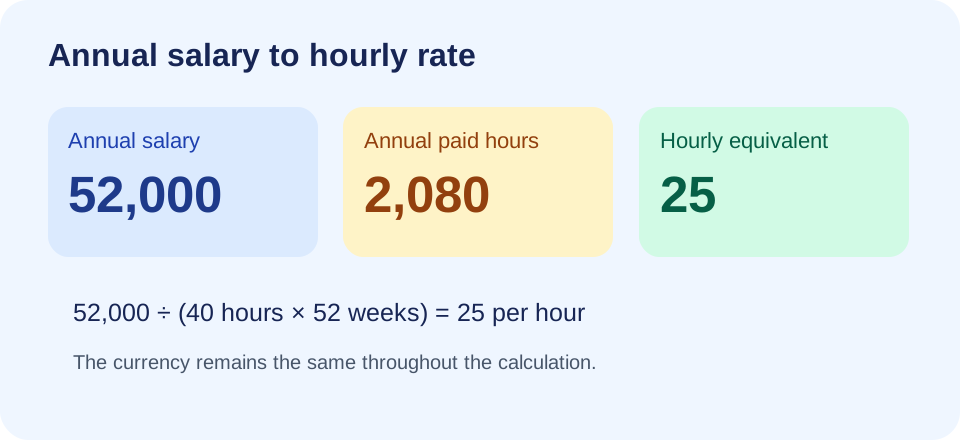
Suppose someone receives an annual gross salary of 52,000. Their usual paid schedule is 40 hours a week, and the comparison covers 52 paid weeks. Start with the total annual hours: 40 × 52 = 2,080. Divide the salary by that amount: 52,000 ÷ 2,080 = 25. The estimated equivalent is 25 per paid hour.
- Annual gross salary: 52,000.
- Weekly paid hours: 40.
- Paid weeks for the calculation: 52.
- Annual paid hours: 40 × 52 = 2,080.
- Hourly equivalent: 52,000 ÷ 2,080 = 25.
That number is not necessarily the hourly wage used on a payslip. It simply distributes the annual salary over the assumed paid hours. To compare offers fairly, record how many hours and weeks each salary represents rather than dividing all annual salaries by a fixed number.
How weekly hours change the result
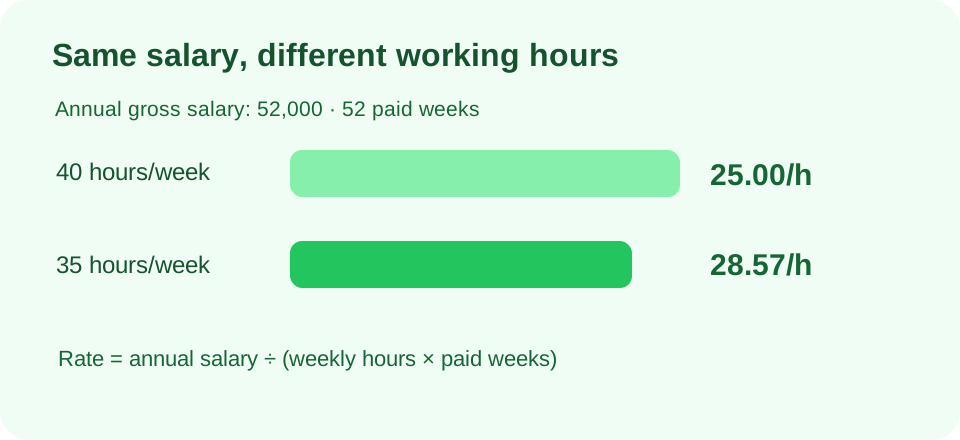
Weekly hours are one of the most important inputs. If the same annual salary of 52,000 covers 35 paid hours each week instead of 40, the annual total is 35 × 52 = 1,820 hours. Dividing 52,000 by 1,820 gives approximately 28.57 per hour. A shorter schedule raises the hourly equivalent even though annual pay is unchanged.
This distinction is helpful when comparing offers with different contracted hours. A role advertised at 52,000 for 35 weekly hours may represent more compensation per contracted hour than one advertised at the same salary for 40 hours. That does not automatically make it the better job: benefits, commute, flexibility, unpaid extra time and workload may matter more to a particular person.
For irregular schedules, use a representative average or your expected total annual paid hours. Multiplying an unusually busy or unusually quiet week by 52 could exaggerate the result. Where hours fluctuate considerably, review actual shifts with a Time Card Calculator before estimating the average.
Paid leave, holidays and weeks worked
There are two different questions people sometimes mix together. One is “How much does my annual salary represent per paid hour?” The other is “How much does it represent per hour I am physically at work?” These are not always the same. Paid vacation and paid holidays can reduce time spent working without reducing annual salary.
If the 52,000 salary is spread across 52 paid weeks at 40 hours per week, the answer is 25 per paid hour. If you instead compare only 47 weeks of active work at 40 hours, you divide by 1,880 hours and obtain roughly 27.66 per active working hour. Neither value replaces the other. They express different denominators and should be labelled clearly.
Do not automatically subtract all vacation weeks from paid weeks. In a salaried position, paid leave is often already included in annual compensation. In other arrangements, unpaid leave changes earnings or paid hours. Use your contract and actual pay arrangement rather than assuming one country's holiday or labor rules apply everywhere.
Comparing part-time and full-time offers
Annual pay alone can make part-time and full-time roles difficult to compare. Imagine a full-time role paying 52,000 for 40 hours per week and a part-time role paying 26,000 for 20 hours per week. If both cover 52 paid weeks, the first represents 52,000 ÷ 2,080 = 25 per hour and the second 26,000 ÷ 1,040 = 25 per hour.
In this example the hourly equivalents are the same, even though the annual amounts differ by half. That does not mean the jobs are equivalent in every respect. Check holiday entitlement, benefits, flexibility, travel costs and expected unpaid work. The hourly comparison is a starting point, not a complete evaluation.
A full-time-equivalent salary is yet another measure. If a 20-hour job pays 26,000 and the reference full-time schedule is 40 hours, the full-time-equivalent annual salary is 52,000, assuming the rate scales proportionately. Keep that hypothetical figure separate from the employee's actual annual pay.
Why overtime needs a separate calculation
The equivalent hourly rate is not a universal overtime rate. Employment laws and contracts differ: some hours may be paid at a higher multiplier, some arrangements offer time off, and not every salaried position receives the same overtime treatment. Never assume a particular premium simply because a salary has been converted into an hourly number.
Once you know the applicable regular rate, overtime hours and multiplier, our Overtime Calculator can estimate regular and additional pay. The inputs should come from your actual agreement or relevant rules. For comparing annual earnings across pay periods, the Annual Income Calculator provides another useful view.
Unpaid extra hours affect the practical value of a job. If a role states 40 weekly hours but consistently requires more, calculating the observed hourly equivalent from actual time may provide a clearer comparison. Do not confuse this observational calculation with a legal finding about whether those hours must be paid.
Common mistakes to avoid
The most common error is applying 2,080 hours to every job regardless of the agreed schedule. Another is comparing gross salary with net hourly income. A third is treating an annual salary as if it included a fixed number of working weeks without checking how paid leave, unpaid time or irregular work is handled.
Be careful with rounding. Perform the multiplication and division before rounding to the nearest cent. If you round an hourly number too early and multiply it back across a full year, small differences may appear. For example, the 35-hour schedule above is approximately 28.5714 per hour; 28.57 is a convenient display value, not an exact rate to unlimited precision.
Finally, do not mistake the mathematics for tax, payroll or employment advice. The result shows what a salary represents under your stated inputs. For a consequential decision, verify deductions, benefits and conditions with the relevant employer or a qualified adviser. The Salary to Hourly Calculator helps you check alternate scenarios quickly.
Frequently asked questions
Should I always divide an annual salary by 2,080?
No. That denominator assumes 40 paid hours per week across 52 paid weeks. Use a denominator that matches the actual schedule or explicitly label it as a hypothetical comparison.
Is a salary-to-hourly estimate before or after tax?
It uses whichever salary figure you enter. For comparisons of advertised compensation, gross figures are often more appropriate. The calculator does not calculate personal taxes or deductions.
What happens if I work 37.5 hours a week?
Across 52 weeks, that represents 1,950 paid hours. Divide the annual salary by 1,950 to get the corresponding hourly equivalent.
Does a higher hourly equivalent always mean a better job?
No. Total earnings, paid leave, employee benefits, working conditions and stability may outweigh a small difference in the calculated hourly rate.