MATH & STATISTICS · EDUCATIONAL GUIDE
How to Calculate Percentage Change: Formula, Examples and Common Mistakes
Percentage change describes how much a number moves relative to its starting value. Learn to calculate increases and decreases, understand the difference between percentages and percentage points, and avoid common errors in reports and spreadsheets.
What percentage change actually measures
A percentage change expresses a difference between two values as a fraction of the original value. The starting point matters because it defines the base against which the new value is judged. You might compare the cost of a service this year with last year, an employee's hourly rate before and after a raise, or a measured quantity before and after an experiment.
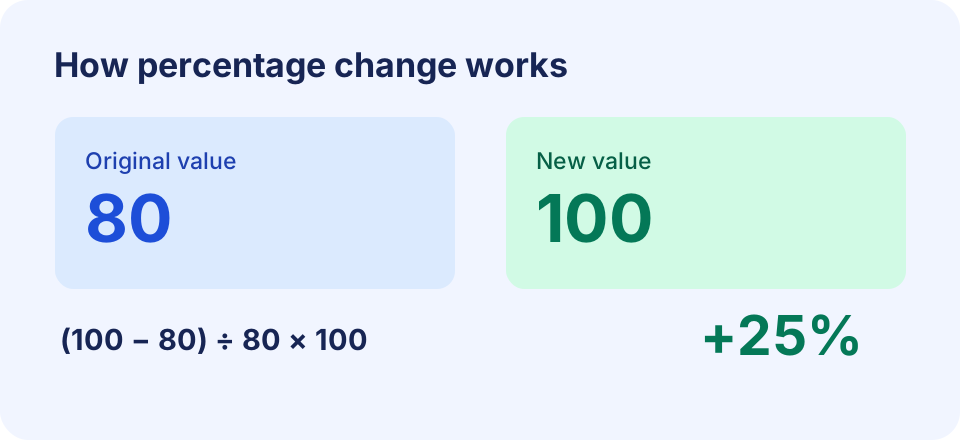
There are two parts to every comparison: the absolute change, measured in the same units as the input, and the relative change, usually expressed as a percentage. Moving from 80 to 100 is an absolute increase of 20 units and a relative increase of 25%. Those statements are not competing answers. They describe the same change from different perspectives.
Percentage change is useful when values have different scales. An increase of 20 units is substantial for a starting value of 80, but very small for a starting value of 80,000. Expressing changes as percentages helps make such comparisons more meaningful, provided the same definitions and measurement methods are used.
The percentage change formula
Subtract the original value from the new value. Next, divide that difference by the original value, not the new one. Finally, multiply by 100 to convert the resulting ratio to a percentage. This yields a signed value: above zero for an increase, below zero for a decrease, and zero when nothing changes.
To verify your calculation, use the relationship new value = original value × (1 + percentage change ÷ 100). For negative changes, the percentage term subtracts from one. This check is particularly valuable when entering calculations into spreadsheets, where swapping columns can silently reverse your interpretation.
If the original value is zero, the standard formula is undefined because dividing by zero is not possible. A change from zero to a positive number may be important, but it should not be given an arbitrary percentage. Report the absolute difference or choose a measure whose denominator is meaningful.
Worked example: calculate an increase
Imagine a monthly price rises from 80 to 100. You want to know the percentage increase relative to the old price. The difference is 100 − 80 = 20. Divide by the old price: 20 ÷ 80 = 0.25. Multiply by 100 to obtain 25%. The price increased by 25%, and the amount of the increase was 20.
- Original amount: 80.
- New amount: 100.
- Difference: 100 − 80 = 20.
- Relative difference: 20 ÷ 80 = 0.25.
- Percentage change: 0.25 × 100 = 25%.
You can check the answer by multiplying the starting price by 1.25: 80 × 1.25 = 100. The same method works for a pay rise, increasing sales, growing distances, or other comparable quantities. It does not tell you whether the increase is fair or beneficial; that requires additional context.
Worked example: calculate a decrease
Now imagine that a price falls from 100 to 80. The difference is 80 − 100 = −20. Divide by the original 100 to obtain −0.20, then multiply by 100: the percentage change is −20%. In ordinary language, this is a 20% decrease. Always state the direction if you omit the minus sign.
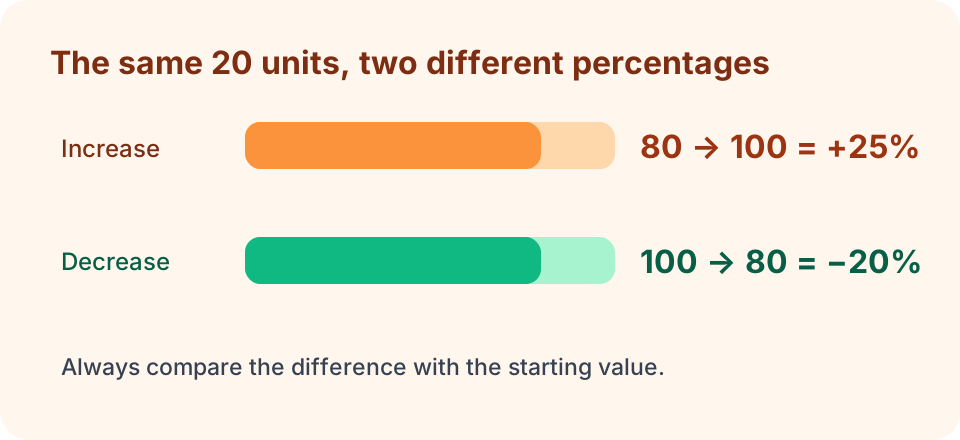
Notice that the reduction uses a different denominator than the earlier increase, despite both moving the amount by 20. A 20-unit move does not have a fixed percentage independent of its starting point. This detail is especially important when discussing discounts, price recovery, and investment losses.
Why the opposite change is not the same percentage
A common mistake is to assume a percentage increase and an equal percentage decrease will cancel out. They usually do not. Starting from 80, a 25% increase produces 100. Applying a 25% decrease to 100 gives 75, not 80. Returning from 100 to 80 requires only a 20% decrease because the starting amount is now larger.
The difference becomes even clearer with a 50% loss. If an amount falls from 200 to 100, it loses half its value. Returning from 100 to 200 requires a 100% increase. That does not mean the arithmetic is inconsistent; it means the denominator changed between the two comparisons.
If you know a final amount after a stated increase and need the original amount, reverse the multiplier. For example, if a price of 120 includes a 20% increase, the old price was 120 ÷ 1.20 = 100. Subtracting 20% of 120 would give 96, which is incorrect because the increase was calculated on 100, not on 120.
Percentage change versus percentage points
When your original and new values are themselves percentages, distinguish percentage points from relative percentage change. If a conversion rate increases from 4% to 6%, it rises by 2 percentage points. Its relative increase is (6 − 4) ÷ 4 × 100 = 50%. Both descriptions are mathematically valid, but they answer different questions.
This distinction matters in reporting interest rates, election polling, test scores, and website performance. Saying that a rate rose by 2% when you mean 2 percentage points can seriously understate the proportional change. In a clear report, include the starting and ending rates and label the difference precisely.
For questions such as “What is 20% of 150?” or “What percentage of 200 is 40?”, use the Percentage Calculator. These questions compare a part with a whole, not a value with an earlier version of itself.
How to calculate the change in Excel or Google Sheets
Put the original value in cell A2 and the new value in B2. In C2 enter =(B2-A2)/A2 and format the cell as a percentage. The spreadsheet will show 25% when A2 contains 80 and B2 contains 100. Because the percentage cell format already multiplies the display by 100, do not also multiply the formula by 100.
To handle a zero starting amount, check the value before dividing. A simple expression such as =IF(A2=0,"N/A",(B2-A2)/A2) replaces an invalid division with a clear label. If your spreadsheet uses semicolons instead of commas as function separators, adapt the formula to its regional settings.
Before filling the formula down an entire column, make sure the old and new data are consistently assigned. Using the wrong baseline can generate plausible-looking percentages that are systematically incorrect. It can also be helpful to keep the absolute difference in a separate column so readers see both units and percentages.
Common mistakes and special cases
Three errors appear frequently: dividing by the new value, confusing percentage points with percent change, and attempting to undo a percentage with the same percentage in reverse. A fourth is treating a percentage change as proof of a cause. The formula describes the size of a movement; it does not establish why that movement occurred.
Negative original values require particular care. For example, a balance moving from −100 to −50 has improved by 50 units, but the ordinary signed formula produces −50%. Calling that a “decrease” can be confusing because the balance became less negative. For measurements that cross zero or involve negative baselines, the absolute difference and a clear narrative may communicate the situation better.
Repeated changes should be applied as separate multipliers rather than simply added. A 10% increase followed by another 10% increase multiplies the original by 1.1 twice, resulting in an overall 21% increase. Likewise, a 10% discount followed by another 10% discount leaves 81% of the original price, a combined reduction of 19%, not 20%.
For a live calculation that handles inputs and displays the result, try our Percentage Change Calculator. For reductions at checkout, the Percent Off Calculator shows the final price and saving. The Ratio Calculator can help if your problem is a relationship between quantities rather than a change over time.
Frequently asked questions
Can percentage change be greater than 100%?
Yes. A quantity rising from 50 to 150 has increased by 200% because the increase of 100 is twice the original 50. For positive starting values, a decrease beyond 100% means the new value has crossed below zero.
What happens if the original value is zero?
The ordinary percentage-change formula is undefined. Dividing by zero is not mathematically valid, so report the absolute difference or choose an alternative measure.
Is a 25% increase followed by a 25% decrease a return to the original?
No. Starting from 100, a 25% increase reaches 125. Decreasing 125 by 25% leaves 93.75. The two percentages use different starting points.
How many decimal places should I show?
Use enough precision to answer the question without implying more accuracy than your input measurements support. For everyday prices, one or two decimal places often suffice; scientific measurements may need a different level of precision.